By Larry Stalcup Contributing Editor
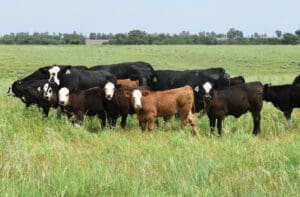
Sideoats grama, buffalo grass and other native forages thrived in late June as generous, above-normal rainfall blessed the northeast Texas Panhandle. Cattle were sometimes knee-deep in Mother Nature’s fodder. To ranchers like David Cook, the premier pastures answered their many prayers after disaster struck in early 2024.
Cook’s third-generation ranch was among hundreds of operations engulfed by wildfires that charred more than a million Panhandle acres in February and March last year. In the mammoth Smokehouse Fire, more than 15,000 mother cows and other cattle died in the roaring inferno whipped by winds surging past 60 mph. Many producers and their families lost their homes, barns, shops and other structures.
By the grace of God, Cook and his wife, Sandie, lost only one cow and her calf. Their home and other structures about 27 miles southeast of Canadian also escaped the firestorm. “We were out of town in Amarillo when the fire hit our area,” David remembers. “My son, Jim David, managed to get to the house from Amarillo to turn on our sprinkler system around the house. He had to maneuver around Wheeler and Allison to get there.”
A neighbor north of the Cook ranch had a quarter-section of wheat that helped repel the fire. “It was like God put a bubble over our place,” Sandie recalls. “Our house and other structures were saved.”
However, most of the Cooks’ several thousand acres of pasture were burned and some fences were damaged. Fortunately, David, Jim David and his other son, Casey, were able to move most of the cattle to pastures that were spared.
If not for hay and other feed supplied by donations from hundreds of producers, agribusiness companies and non-profits from Texas, Oklahoma, Kansas and many other states, the Cooks and other ranchers would have been forced to sell more cattle.
Native Grasses Thrive
The wildfire exploded after a perfect storm of dry conditions, high winds and a downed electric utility pole in a nearby county. Rain was also sketchy for the remainder of 2024. The southern High Plains region averages about 18 inches of precipitation per year. But the accumulation may be 28 inches one year and 8 and the next. Ranching and farming are always a gamble.
Thankfully, the northeast Panhandle’s rolling hills region is blessed with native forages that can often thrive in that climate. buffalo grass, sideoats grama and other grasses can provide a perfect spread for cattle in minimal conditions. That’s what attracted David’s granddad, Bud Harden, to invest in the area in about 1920.
“Granddad kept adding to it with additional land purchases a few miles north and west of here,” David says. “In one pasture, known as Rattlesnake Hill, the U.S. Coast and Geodetic Survey agency buried a stone marker to provide a known point for surveyors to map oil and gas wells.”
David’s father, Claude Cook, was raised on the ranch that included wheat farming. In the 1960s, both men took advantage of the Great Plains Conservation Program, which helped support the terracing of the rolling contour. The conservation efforts helped the pastures retain more moisture when rain and snow did occur.
David grew up on the place and met Sandie at West Texas State University (now West Texas A&M) in Canyon. She was from Boise City in the western Oklahoma Panhandle and is certainly familiar with the region’s sometimes-harsh weather. After they were married and finished college, they moved back to Canadian in 1969.
“Dad started turning the country over to me,” David says. “We continued running stocker cattle and farming. We bought cattle from Georgia, Louisiana and East Texas. They were good cattle of all breeds but with little Brahman influence.”
The calves arrived at about 350 pounds. The Cooks processed most of them by horseback. “We’d get them in and doctor them. We kept our death loss at about 2 percent, which was lower than most processing crews we sometimes used,” David says. “We grazed them to about 800 pounds and sold them at regional auctions.”
While still farming, the Cooks placed about 1,200 acres into the Conservation Reserve (CRP) Program when it started in the 1980s. When their CRP contracts expired in the 1990s, they built cross fences for rotational grazing. The improved grazing program got the most out of the native pastures.
In the early 2000s, the Cooks eased into cow-calf production, which continues today. “We run a crossbred program. Different crosses of cows are bred to either Angus or Hereford bulls,” David says, adding that he considers EPD data when selecting sires. “We’re using Hereford bulls right now. They are docile, which eases the handling of the herd.”

The Cooks generally don’t keep heifers for replacements, especially with high calf prices. “I have cattle buyers at Beaver and Elk City [Oklahoma] auctions who purchase 3- to 5-year-old cows that will be in their third trimester in the spring,” he says. He prefers that practice over the time and cost involved in raising heifers to where they’re large enough to breed.
Cattle are supplemented with a liquid feed ration that’s 32 percent protein with a mineral pack. “Since this has been a wet year, there are concerns about foot rot,” he says. “But we haven’t seen any so far. We’re hoping that trend continues.”
David notes that calves receive early vaccine treatments for respiratory and other disease prevention. Just after weaning, calves are normally marketed through either the Beaver or Elk City sales or Superior Livestock Auction. However, David has sometimes retained ownership of calves or yearlings fed at Buffalo Feeders in Oklahoma. That helps him gauge the quality of cattle raised and earn extra profit when the market is right.
David has worked closely with Hemphill County Extension Agent Andy Holloway. He served on Holloway’s first committee to establish the ever-popular Hemphill County Beef Conference.
“David is a solid, above-average rancher,” Holloway says. “He practices good pasture management and weed control. He’s not an over-grazer. That’s such an important act of stewardship. Others should pay attention to those practices. We’ve had good rain this year and we’re in good shape. But if we get into a dry situation, you need pasture that will grow something.”
David is even Holloway’s Sunday school teacher. “He and Sandie are loved by their community,” Holloway says. That closeness was sanctified when the wildfire smothered Canadian and much of the region. “When we drove back home after the fire, many of the landmarks on the highway had been destroyed,” Sandie recalls.
One was the old Blue Ridge School that David attended. Only a chimney remains standing. The schoolhouse, barns, shops, sheds, fences, equipment and homes lost in the Smokehouse Fire belonged to the Cooks’ friends and neighbors. Some were members of the Gem City Fire Department, one of dozens of volunteer fire departments (VFD) that helped battle the monster blaze.
“We started the Gem VFD in 1978,” David says. “It’s about 2 miles from our house. We received funding from the county for equipment and our first truck. I also got a grant from the Texas Forestry Service to buy equipment.”
Like the other VFDs, the equipment was severely worn after fighting the Smokehouse. Tires virtually melted. Pumps and engines played out. Mercifully, financial assistance came from the 100 Club of the Texas Panhandle.
The 100 Club, headquartered in Amarillo, is a non-profit that supports the families of first responders injured or killed in the line of duty (this writer proudly serves on the 100 Club board of directors). It also helps fire and law enforcement agencies improve equipment.
Through the generosity of lenders and other businesses across the Panhandle area, the 100 Club was able to distribute more than $900,000 to more than 50 Panhandle VFDs.
Through guidance from the Texas AgriLife Extension Service, USDA and other local, state and national agencies, producers were able to obtain help for replacing fencing and other ranch structures. Thousands of round and large square bales of hay from at least a dozen states were donated and trucked to the burned areas.
Even though moisture was scarce earlier this year, the region escaped major fire damage. The added rain in the spring and early summer provided just what the native grasses thirsted for.
As parts of the Panhandle bloomed into an oasis for cattle, the Cooks and others are praying those rains continue.