By Rachael Sebastian Contributing Editor

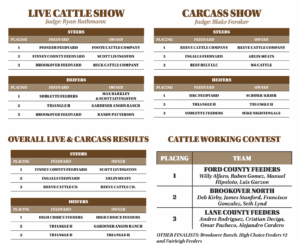
Cattle processing usually isn’t a spectator sport. It’s not a sport at all, and rarely are there spectators. But during Beef Empire Days in Garden City, Kan., a celebration of the beef industry in southwest Kansas, processing teams compete to be named the best. And in June at Cobalt Cattle, the top 6 final processing crews in southwest Kansas were named during the Cattle Working Contest.
Workers from Zoetis judged the event. Zoetis’ Kassity Tucker helped coordinate and manage transportation for the crews to get the barn to compete.
Tucker says the event showcases what happens when cattle arrive at a feedyard.
“When you get a pen of cattle in a feedyard, they need to go through a processing barn in order to get vaccines and medications if they’re high risk, meaning they’re at higher risk of getting sick,” she says.
The processing crews also administer implants, which help increase performance, Tucker says.
“With the implant they gain more pounds but stay leaner and gain more pounds throughout the production phase on feed in the feedyard,” she says.
Although the job tends not to be glamorous, the contest gives crew members a chance to be recognized.
“We want to give gratitude to [the cattle working crew]. They do what people call a menial job because they’re just doing thousands of head every day. So this is a nice contest to put a little competition in it.”
The crews are judged on cattle handling, vaccine administering, implant placing and the attention to detail in those tasks.
“They’re getting judged on how well they give the vaccine, how often they change needles, how they implant the animal and how well they give the de-wormer,” Tucker explains. “It’s really more an attention-to-detail process within the barn,” she says. “They’re getting points for having more attention to detail while doing their job as smoothly and safely as they can.”
The crews are not outright judged for time, but get more points for finishing the pen under a certain amount of time.
They’re judged more on care in handling.
“Speed is a factor, but we want to stress safety for the animal and safety for the crew – just being as efficient as we can be,” Tucker says.
Dalton Rutledge, also from Zoetis, was one of the chute judges at the Cobalt Cattle feed yard.
“We’re really looking at how they bring cattle up from the back alley,” Rutledge says. “We look at how they run the chute. We don’t want them banging it, we just want them to squeeze. We also watch how they stand cattle back up if they go down.”
Not many people typically attend the annual event, but spectators were plentiful this year. Kitty Banning, third-generation farmer and rancher, was there with her daughter-in-law and granddaughters. They are her processing crew at her family’s ranch in Hamilton County. Banning says the family just processed their cattle a week before the event.
“I thought, hey, Beef Empire Days is coming, and I knew about this event, so I looked it up and thought we should come,” she says.
Banning and her crew made friends with the Fairleigh Feeders team from Scott City, Kan., and watched them process. The crew had Luis Manzano and Josue Mejia working the back alley, pushing cattle, and Esther Arreola worked the squeeze chute. At the head, Margie Arreola did tagging and implanting.
“We really wanted to see how the professionals do this,” Banning says.” Today we get a better understanding of what we do, compared to how the next step of the industry works.”
Armando Caballero, Cobalt Cattle’s manager, spent time with Banning and her family, pointing out how the chutes worked and what the processors were doing.
“Day in and day out, these crews are doing this at the yards. Their work is invaluable to what we do here,” Coballero says.
Alyssa Banning, Kitty’s daughter-in-law, was one of the onlookers at the competition. She didn’t grow up around cattle, and says her husband and Kitty have been gracious in the way they’ve taught her cattle handling and care.
“It’s a whole family effort what we do,” Alyssa says. “We don’t have all of the fancy equipment they have here, and we go at a much slower pace. We have to deal with the mama cows again next year, whereas the processing crews are moving them to where they’re going next. But in the end, cattle are cattle and we are doing a lot of the same things they are.”
Callie Phillips, one of Banning’s granddaughters, says she really enjoyed watching the crew work.
“The coolest part is how fast they can get through all of this,” she says.
Sierra Banning, 11, is another granddaughter.
“Watching this will help me learn. And helps me get better at pushing them through gates and handling the cattle,” she says.
Haven Banning, 12, was amazed at how fast the crew worked.
“They go so much faster. Watching Margie take out tags, put in new ones and implant was the coolest part,” she says.
Banning’s crew of women has help from her husband and son at home, but they weren’t with them that day to watch. She says her girl crew enjoyed watching Margie and Esther work. Banning has a generational herd that she purchased from her parents. She already sees the love for farming and ranching being passed down to her enthusiastic crew.
“This is important work we do. And I’ve got generations four and five with me here today,” she says.