By Patti Wilson Contributing Editor
A new conundrum has arisen among the ranks of the purebred cattle industry. It first erupted in April and, like every other controversy, has two sides.
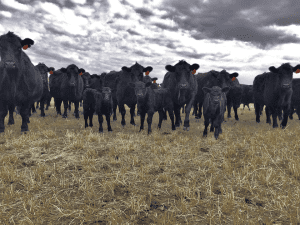
The American Angus Association (AAA) has never been one to back away from controversy. (Remember the “elephant ads” in the late 1970s?) This time, they have taken up with Jeff Bezos and his Bezos Earth Fund. The Earth Fund and accompanying Global Methane Hub are encouraging the breeding of low-methane-emitting Angus cattle. The AAA is ruminating on the possibility of adding a methane-related expected progeny difference (EPD) to their growing list of EPDs. Thus, they have placed themselves squarely in the middle of the Bezos project.
Global Methane Hub describes itself as “The emergency brake on global warming.” Heavily invested in diversity, equity and inclusion (aka DEI), they explain their activity, in part, as: “We fund and convene organizations that are reducing methane on the ground in the best way for their communities, serve as a central hub for information about methane mitigation and advocate for free data sharing.”
Further, their vision statement is, “A world where a dramatic reduction of methane emissions by 2030, coupled with rapidly decreasing carbon dioxide and other greenhouse gas emissions, keeps global warming under 1.5 degrees Celsius, averting climate catastrophe and bringing social, environmental, health and economic benefits to communities, cities and countries.”
What Does It Entail?
Reportedly, a $4.85 million grant from the environmental organizations will be managed by the Angus Association, which will, in turn, will receive a 3 percent administrative fee ($145,000). The grant money, administrated through the Angus Foundation, will support Angus Genetics, Inc. (AGI), and the University of New England. It will reportedly be used to fund research for the reduction of methane emissions from Angus cattle through selective breeding. Money from the administration fees paid to the Angus Association will help fund scholarships and youth programs within AAA.
This is one part of a Bezos Earth Fund $27 million global project to screen more than 100,000 cattle across North America, Africa, Latin America and Europe, eventually reducing global methane emissions by 1 to 2 percent annually, or potentially 30 percent over 20 years. The research project itself is expected to take five years. AAA will oversee the collection of 4,600 methane genotypes in the United States.
Participating in such science supposedly enables Angus to lead in sustainable agriculture. Additionally, it provides ranchers with a voice in global discussions about livestock and climate. AAA says it enables AGI to influence how Angus genetics are represented in climate solutions.
The grant pays for research without any cost to AAA members. Youth and education programs are financially enhanced, and identification of low-methane-emitting cattle can begin.
In an Angus Journal article, AGI President Kelli Retalik-Riley said that cattle that are more efficient in their methane production, as is suggested, may also be more efficient in general. According to Retalik-Riley, they are “lower input cost kind of cattle. If we can quantify that and make it possible to genetically select for these cattle, then that will be a win-win for all of us. Any time we can equip Angus breeders with science-based tools that can help them drive meaningful genetic progress in their herds- with no cost to them – that’s a huge success.”
AAA recognizes this topic is complicated and can be filled with strong emotions. The AAA website states, “Some believe there is more risk in being involved in the research around methane as it gives credence to our critics. Others believe there is greater risk in not being involved and letting others have the data and control of our fate. Some suggest any engagement is wrong and supports an activist agenda.
“After much consideration of the options, the choice was made to engage in the research, be involved in directing the project, and ultimately have more influence on changing the false narrative around cows and climate.” The methane studies are related to feed efficiency, lifetime performance and beef quality traits.
The Bezos Earth Fund has no authority to influence or alter the direction, design or use of the research. The research itself could be used to develop new selection tools for the existing Angus Feed Efficiency EPD. AAA will have final decision on what selection tools, if any, would be included on registration certificates.
The Flip Side
Critics of this program abound, and they are loud. They want us to remember that the Bezos Earth Fund has awarded $100 million for development of plant-based and lab-grown meats. Ranchers are understandably concerned this can undermine our market share. Accepting Bezos’ money surely presents a conflict of interest. Those opposed say the research is unneeded; they cite studies done by UC Davis in 2020, where cattle were determined to emit methane with a short-lived biogenic carbon cycle, not a climate driver. Also, cattle methane emissions are declining with smaller herd sizes, and the quest to vilify our livestock is overblown.
From a political standpoint, opposing AAA members complain that the association’s board of directors’ decision to accept the Bezos grant was made without broad member consultation. Some members feel the board is prioritizing money over their interest. Social media has erupted with plenty of negative feedback.
THE AAA IS RUMINATING ON THE POSSIBILITY OF ADDING A METHANE RELATED EXPECTED PROGENY DIFFERENCE
(EPD) TO THEIR GROWING LIST OF EPDS.
A Practical Perspective
On Sept. 30, the Trump administration directed the Department of Energy (DOE) to drop climate change language, citing its original inclusion as a scare tactic for the general public. Such terms as “global warming” and “methane mitigation” and vilification of livestock are to be ousted.
One outspoken critic to methane EPD development and the Bezos grant is South Dakota veterinarian Jim Stangle. His practical take on these matters is refreshing and grounds us. In a Bison, S.D. Courier article he wrote that EPDs are useful and important, but he believes we already have plenty of traits in our EPD toolbox. He listed some that he considers not very important, such as shedding (“What are they [cattle] … poodles?” he asked) and hoof angle. Even the more useful traits like birth weight and weaning weight, for example, are not as impactful as mothering ability, for which there is no EPD. He emphasized that the first and most important thing a cow must do is to reproduce at regular intervals and raise a calf. Longevity is tied to this trait, as well.
Dr. Stangel addressed the Angus Association/Bezos issue. He pointed out that, “Cows don’t produce methane, rumen bacteria do! They are in the guts of cows, sheep, goats, deer, antelope, dogs, cats, humans, grasshoppers, termites. They are in the newborn calf before they are born, or as soon as they pass through the birth canal. Destroying bacteria would be literally impossible, they are in every organ. Reproduction is 80 to 90 percent of the value of animals.
“There is no amount of good from reduced reproduction than can be made up by methane reduction,” he wrote. “Paradoxically, any reduction in reproduction would mean more replacement heifers and more bulls and thus more methane.”
There’s the conundrum. What’s your opinion?