By Larry Stalcup Contributing Editor

Price volatility has done a whammy on cattle markets recently, causing major swings in feeder cattle and fed cattle markets. The outlook for 2026 markets still looks strong, but prices will likely face as much or more volatility, which puts added pressure on managing financial risk.
Herd rebuilding has started slowly, but some producers haven’t recovered enough from droughts to have enough grass for expansion. And with continued high cattle prices and strong demand, cattle supplies will get tighter before they expand, contends Stephen Koontz, Ph.D., Colorado State University livestock marketing economist.
“Heifers have to be held and cows have to be held,” he says. “There is some evidence of holding cows, but nothing yet on the heifers. We will see in January with the USDA cattle report. I think the news there will be tepid.”
These supply-and-demand fundamentals spell high prices. “The cattle and beef outlook for 2026 is the easiest job I’ve had since doing the cattle and beef outlook for 2025,” Koontz says. “As long as demand remains strong, there will be excellent cattle prices.”
Koontz forecasts that, for the first quarter of 2026, 500- to 600-lb. calves will average from $400 to $420/cwt. His second-quarter projections are between $410 to $430; third quarter $430 to $450; and fourth quarter at $425 to $450. “Again, tight supplies will continue into 2026,” he says. “We should not expect increased supplies of calves for two or three years.”
For 700- to 800-lb. feeder cattle. Koontz projects first-quarter feeder prices at $325 to $350/cwt.; $335 to $365 for the second quarter; $345 to $375 for the third; and $350 to $365 for the fourth.
For fed cattle, tight feeder supplies will help hold prices firm but could face “huge pressure from cheapening other meats,” a potential shift in consumer income and continued inflation, Koontz says. He forecasts first-quarter fed prices at $225 to $235/cwt; second quarter at $230 to $250; $240 to $250 in the third; and $225 to $240 in the fourth.
He sees cow prices also remaining high due to cow shortages and the demand for more burgers. “They will likely range between $165 to $199/cwt. all year, with prices higher in the summer and fall,” Koontz says. “Ground beef will be the most affordable beef product. That consumer demand and more herd building will keep cow numbers low.”
Demand Risk
Consumer food-buying habits are a threat to cattle prices. “The greatest potential weak link is beef demand. The risks are all downside,” Koontz says. “Some weakening of the economy, relatively low substitute meat prices in pork and chicken and continued inflation could put pressure on cattle markets. Again, the risks are to the downside with generally very strong prices.”
As cattle prices remain strong, packers continue to feel more pressure. “The other risks are market disruptions from administrative edicts, and I believe we will lose packing capacity over the next two years,” Koontz contends. “There are not enough animals [for slaughter] now and for the next several years. We have much more capacity than animals. Packer problems will be the thing we talk about more through 2026.”
Don’t Risk the Risk
Not even the most astute market analysts and university livestock economists could have predicted the dumbfounding, sky-high prices for nearly all cattle. Despite $6/lb. ground beef, $30 to $40/lb. ribeyes and other costly cuts, consumers have kept buying beef. Those juicy burgers and incomparably delicious steaks have been worth the price.
But when have high cattle prices ever not come down, even if temporarily? Markets reacted instantly to President Trump’s comments on increasing beef imports from Argentina and other administration efforts to increase cattle production. In its Nov. 4 Market Watch report, Commodity and Ingredients Hedging (CIH) indicated both live and feeder cattle futures sold off sharply in the second half of October following commodity fund liquidation in response to President Trump’s recent comments regarding high beef prices and the need to bring them down.
Nearby feeder cattle futures plunged 16 percent from $380/cwt. to $320 in the January futures contract, CIH reported. February live cattle futures dropped around 12 percent from $250/cwt. to just above $220 as the White House announced several initiatives to help lower beef prices. Those additional measures include possibly reopening the border with Mexico for the resumption of feeder cattle imports.
The controversial tariff rate quota available to Argentina would quadruple the volume to 80,000 metric tons, or just under 180 million pounds. However, that’s just a fraction of the 25 billion pounds of beef produced in the U.S.
“Do the math on the change in the quota and compare it to 25 billion pounds,” Koontz says. “Fed cattle and calf prices have been too high all year. I don’t think it was the import comments. The market was looking for something to trigger selling – and that just happened to be it.”
Should You Fix a Floor Price?
When the $380/cwt. futures price for January ’26 feeder cattle dropped to $320, it was about a $420-per-head hit for seven-weights. Of course, the $320 was still well above the $250 market in early February. But the $60/cwt. that was lost could have been partially protected with Livestock Risk Protection (LRP), options or straight futures hedges.
“It is just advisable to buy LRPs,” Koontz says. “I perceive the risk as to the downside. Tight supplies are guaranteed. That will hold prices up. But surprises will be bad news.”
Mike Moroney, CIH senior vice president of client services, says a sturdy risk management plan “is imperative in markets like this when the equity-per-head swings are in excess of $500 per head.
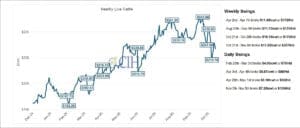
value per head show the importance of financial risk management. Photo courtesy Mike Mohoney, CIH
“There are no easy risk management solutions in a market like this,” he says. “Everyone wants all the upside with no downside and wants it for free. That isn’t reality. However, producers can blend insurance alternatives with exchange positions to create ranges of protection at a more affordable price.”
For example, Moroney says, in early November, the LRP fed cattle offering for a Feb. 12, 2026, $219.75 coverage level was $7.90/cwt. “A producer could have paired that with an obligation to be short on the CME at $236 by selling Feb. $236 call options for $2.70/cwt. That would create unlimited downside protection with room for opportunity up to $236 at a cost of $5.15/cwt. If the market were to run up beyond $236, the producer would be obligated to be short. Net of all costs, the producer would be short at $231.85.”
Moroney says an LRP/call options strategy may also help provide feeder cattle price protection at a lower cost. For example, with the LRP March feeder cattle contract at $312 in early November, a producer could have secured an LRP to protect that price for $14/cwt.
“Your net price protection after premiums for the LRP would have been $298. The same LRP/call options strategy could have been used to cheapen it up. As an example, a producer could have sold the March feeder cattle $340 call for approximately $6.25/cwt. The resulting coverage cost would have been $7.75, netting the producer a minimum price of $304.25 and a maximum price of $332.25.”
“Remember, we were all celebrating when we finally crossed $300 back in July,” Moroney says, noting that LRP contracts change regularly, but should still provide opportunities for producers and feeders to help manage their financial risk.