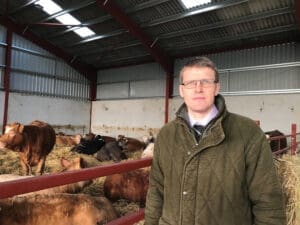
By David MacKenzie Contributing Editor
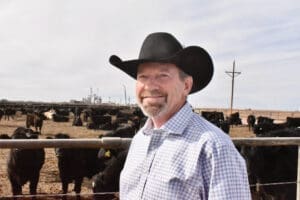
When you arrive in Hereford, Texas, it is very clear that you are entering the “Beef Capital of the World.” The U.S. has fully claimed this title with the scale and continued commitment the nation has to producing beef. This was brought home to me during my visit earlier this year when, regardless which state we were in or restaurant we visited, the tenderness and flavor of the beef was consistently exceptional.
So what is the difference between the two beef industries and how can the U.K. replicate this consistency? First, the scale of the U.S. is completely different from our island. The U.K.’s land mass is similar to the state of Oregon, while the U.S. population is considerably bigger at 342 million compared to 69 million in the U.K. The U.S. has nearly 10 times more cattle, but one stark difference is average beef consumption, reported at 67 lbs. per person in the U.S., compared to a U.K. average of 37 lbs. per person.
The importance of food production to any nation is an absolute priority. It is clear to me that beef production is close to the beating heart of the U.S., where it certainly hasn’t been for a number of years in the U.K. Agriculture, specifically livestock production, is currently struggling to find a place in government policy and playing a distant second to renewable energy.
Genetic lines are largely following the same path, with Angus being the dominant breed in both the U.S. and U.K., and Holsteins making an ever-larger percentage of the dam line. Our native breeds like the Aberdeen Angus, Shorthorn and Hereford compete with the European Charolais, Simmental and Limousin. Angus has an untouchable brand that is recognized and reaches directly to the consumer. It’s the first choice for the dairy farmer with Wagyu also now coming into the market.
There are individual and locational differences in ranchers in every country, but one area that I have clear admiration for Americans is on feed intakes. In the U.K., we simply fed cattle to appetite and predicted intake, and make management decisions simply on the financial performance between buying and selling while estimating the “bit in the middle.”
Respected cattle feeder Tom Jones at Hy-Plains Feedyard at Montezuma, Kan., said, “Rather than being the biggest, be the best, and the only way to do that is on data.”
Jones was a great leader in articulating what data is important and why it makes a difference and then linking that all the way through from the genetics, through the packer to the retailer. Although in the U.K., we are moving toward having a better link through our integrated beef from dairy schemes, our cow-calf systems are largely transactional, and no data follows back through the chain.
The connection the whole U.S. cattle industry has to academia was demonstrated on my recent visit at both Texas A&M in Amarillo and at Colorado State University at Forth Collins. The focus on training the next team that is going to drive the industry, alongside researching the latest science, while reaching out and listening and reacting to the day-to-days pains ranchers experience, gives a platform for industry improvements.
When an animal is harvested at the packing plant, the gap between the two countries is huge. Our harvest percentage of 52 to 54 percent between live weight and paid carcass weight at the packing plant is considerably different from the 63 to 64 percent with yourselves. The U.K. runs a system of grading cattle from E–U-R-O-P and 1 to 5 fat cover where a side of beef is evaluated either by a computerised visual assessment or a manual grading. No link to the consumer is carried through, and nothing is evaluated for dark cutting or intramuscular marbling – a clear mile away from the very clear Prime, Choice and Select USDA Quality Grade system.
Our ranches and feedyards are not just businesses, they are our passion and purpose in life, regardless of which continent they are based. In the United Kingdom, we have a wonderful landscape coupled with natural resources, all pulled together with committed beef farmers. However, from what I have continually experienced, I have to hand it to the United States in the consistency and tenderness of meat being produced. Could this be the clear reason why your beef consumption is so much higher?