By Blaine Davis Contributing Editor
What appears to be an annual ritual, my family bid farewell to 2025 and welcomed in 2026 at “My Happy Place.” With all the daughters and their significant others and six grandchildren, Tammy and I brought in a new year, celebrated a belated Christmas and two kiddos’ birthdays. While the weather has been unseasonably warm in Kansas with me still donning flipflops and cargo shorts through the end of December, the warmth of the beach and the crashing waves of the Gulf of America was a welcome respite. Ushering out the year 2025, my son-in-law Jake, whom I judge to be a “pitmaster” prepared two Prime briskets from my favorite purveyor of beef, Guthrie, Texas’, 6666 Ranch. With his expertise and my minimal assistance, I am sure very few others on the island ate this well.
As per my normal routine, I was in bed hours before midnight. I celebrated the coming of the new year on schedule with the folks in Europe. As I am often quoted, “It is nothing but amateurs’ night out.” But actually, I was preparing for an early arising to prepare a kettle of black-eyed peas. New Year’s Day was the 18th Annual Black-Eyed Pea-Off, a competition hosted by “The Gaff,” a Port Aransas institution and watering hole and also home to Texas’s belt-sander races. While my entry, I dubbed “Papa got to Pea” in honor of my grandkid’s moniker for me, was just one of the more than three dozen, I didn’t receive any honors, but I am counting on a year of good luck and the local animal shelter benefacting from the event.
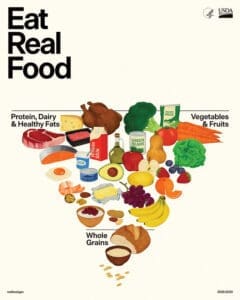
Upon return to the cold, frigid north, I caught up with some news from the AgWeb internet site accompanied with a satisfying grin. New dietary guidelines were being passed on by United States Department of Agriculture and the Health and Humans Services flipping the food pyramid upside down. The White House delivered a simple but clear message to Americans: Eat real food.
“We are finally putting real food back at the center of the American diet. Real food that nourishes the body, restores health, fuels energy and builds strength,” says Secretary of Agriculture Brooke Rollins. “This pivot also leans into the abundant, affordable and healthy food supply already available from America’s incredible farmers and ranchers. By making milk, raising cattle and growing wholesome fruits, vegetables and grains, they hold the key to solving our national health crisis.
Rollins says the previous dietary guidelines demonized protein in favor of carbohydrate. “These guidelines reflect gold standard science by prioritizing high-quality, nutrient-dense foods in every meal,” Rollins says. “This includes a variety of animal sources, including eggs, poultry, seafood and red meat, in addition to plant-sourced protein such as beans, peas, lentils, nuts, seeds and soy.” To put the new protein recommendations into perspective, Sigrid Johannes, National Cattlemen’s Beef Association executive director of government affairs, says for folks who should be consuming 1.6 grams of protein per kilogram of body weight, that’s a 100 percent increase in recommended daily protein intake.
Just beyond my proverbial “Ranch Gate,” southwest Kansas beef producer Marissa Kleysteuber describes the new “commonsense” dietary guidelines as “exciting and refreshing.”
“As beef producers, we are blessed to work with a ruminant animal that can utilize Mother Nature’s production of cellulose from rain and sunshine and then convert it to one of the most nutrient rich proteins there is,” she says. Quintessentially American foods such as burgers, steaks, pork chops and Easter hams can remain a staple of American households, and the guidelines go so far as to recommend parents and grandparents introduce nutrient-dense foods, including meat, early and throughout childhood, much as my grandkids can attest to.
Dairy emerged in a strong position under the new dietary guidelines, with federal nutrition guidance supporting dairy at all fat levels for the first time. “One of the key messages they’re telling consumers is eat dairy at all fat levels – that’s whole milk, cheese and butter,” says Matt Herrick of the International Dairy Foods Association. He calls it “a significant watershed moment,” reflecting how many families currently eat and shop today. With my own dietary demand, Herrick notes, “When it comes to protein, consumer demand is reshaping the category, with cottage cheese at its highest level since in 1980s.” Further Herrick notes, “We’re going to continue to see investments in processing facilities – new plants, updated lines and more capacity – to meet growing consumer demand for dairy protein and healthy fats.”
Dairy and meat weren’t the only items to top the dietary pyramid. Fresh fruits and vegetables were also given top billing. “Diets rich in vegetables and fruits reduce risk more effectively than many drugs,” says Secretary of Health and Human Services Robert F. Kennedy, Jr. The new dietary guidelines recommend three servings of vegetables and two servings of fruit per day. Though not explicitly stated, the updated guidelines also called out “frozen, dried or canned vegetables and fruits with no or very limited added sugars” as good options.
After the dust settled from the return trip back to Kansas, I reflected on a week of sand, surf, a chartered fishing trip with my go-to guide, beach games and general chaotic fun with the family. What could be labeled as “preaching to the choir,” the new dietary guidelines were that of our status quo throughout the week, as the family partook of meals rich in protein from well-aged steaks, burgers and divinely smoked brisket from my backyard paradise to fresh seafood, such as locally farmed oysters and fresh Gulf shrimp devoured on the bay. I bid farewell to 2025, and with a spoonful of protein-rich black-eyed peas I say, “Welcome 2026!”