By Larry Stalcup Contributing Editor
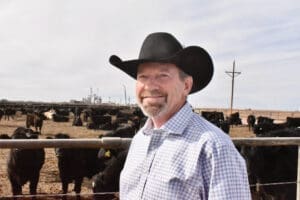
Laphe LaRoe still had his baby teeth when he cleaned his first feed bunk and scooped his first manure pile. At 54, he hasn’t stopped monitoring cattle feeding operations since then.
LaRoe, director of operations for Smith Cattle Co., LTD, headquartered in Amarillo, is the new Texas Cattle Feeders Association (TCFA) chairman. TCFA represents 163 member feedyards in Texas, Oklahoma and New Mexico. Those yards finish more than 5 million cattle per year, some 25 percent of the nation’s fed-cattle supply.
Among those are five Texas Panhandle feedyards that operate under the Smith Cattle Co. umbrella. Under the direction of Levi Berry, the feedyards include CanTex Feeders in Hedley, Quality Beef Producers in Wildorado, Quien Sabe Feeders in Happy, Tejas Feeders in Pampa and Tierra Blanca Cattle Feeders in Hereford.
“Our one-time feeding capacity is 297,000 head,” LaRoe says. “There are different partners in each operation. I office out of my pickup and schedule incoming and outgoing cattle and overall production at the feedyards.”
Most of the cattle are procured from sale barns across Oklahoma and the Texas Panhandle, with a few acquired from other parts of Texas and the Southeast. Many of the cattle are bought, straightened out and preconditioned by partners in the various yards.
LaRoe grew familiar with the regional cattle feeding scene when his family lived in a house provided by Hartley (Texas) Feeders, then a small feedyard managed by his father, Bill LaRoe. “I started helping with the yard’s chores as far back as I can remember,” Laroe says. “That included scooping bunks and shoveling manure.”
He attended elementary school in Hartley through the eighth grade. The family then moved to Amistad, N.M., where his father managed a large, 26-irrigation-circle farm and stocker operation. “It was about 40 miles south of Clayton, N.M., and adjacent to the Texas border,” he says. “I showed cattle and horses in 4-H while at Clayton High School, which was a 45-minute bus ride from Amistad.”
Over the weekends, he processed cattle, drove a tractor or baled and stacked hay. “You never forget that type of farm work,” he recalls.
After graduation, he attended Clarendon College in the southeastern Panhandle, then Panhandle State University in Goodwell, Okla. From there he moved to Dalhart, Texas to work for Cargill’s then Caprock Feedyard. Bo Kizziar was manager. From riding pens to shipping and buying cattle, LaRoe spent 11 years at Caprock and later Cargill’s Amarillo office.
He also managed McLean (Texas) Feedyard for 13 years before Levi Berry, a longtime friend and manager of operations at Smith Cattle Co., convinced him to manage CanTex Feeders.
While he works from his pickup, LaRoe and his wife, Alice, live in Canyon, Texas. Their sons, Chance, 31, and Chandler, 25, are partners in a separate cattle operation owned by Laroe.
His long involvement in cattle feeding led to his role as director of operations in 2021, and deeper involvement in TCFA. “I learned a little about TCFA from my dad and eventually was honored to serve on the TCFA Board of Directors on two different occasions,” LaRoe says. “I was elected to be part of the officer rotation in 2023.”
TCFA Maintains Resilient Voice in State and National Policy
TCFA has long been a key player in developing policy for the National Cattlemen’s Beef Association. It has also been strongly active in Texas regulatory and taxation policy.
“Through all of my trips to Austin and D.C., I soon realized TCFA is well recognized at state and federal levels,” LaRoe says. “That recognition helps to protect our feeders’ freedom to operate. There are always one or two hot topics, but there are a multitude of topics that TCFA is always working on at the state and national levels.”
No issue has garnered more attention than the New World screwworm (NWS) threat from Mexico and further south. NWS cost the U.S. beef industry hundreds of millions of dollars in the 1960s before the pest was eliminated. With cases of NWS identified a few hundred miles from the Texas border, USDA and cattle groups are building a force to help monitor and prevent major outbreaks and treat potentially infected cattle.
“We know the damage that NWS did in the past,” LaRoe says. “Preventing reintroduction of the screwworm is our first priority.”
The closed border has impacted many Texas feedyards and the nation’s overall cattle-on-feed numbers this year. With an open border, about 1.2 million cattle cross into the United States. The loss of those cattle, plus the overall low cattle supply, has caused some yards to struggle in keeping pens filled. “The USDA Cattle on Feed report released last month showed November placements at 1.6 million head,” LaRoe says. “That was the lowest number printed since the inception of the report in 1996. The need for additional cattle is evident.”
He adds that TCFA is working with USDA to safeguard cattle health. “This is done with close coordination with federal and state agencies for research, response protocols, treatment options and science-based domestic zoning and regionalization,” LaRoe explains. “TCFA is a founding member of the Screwworm Coalition of Texas (screwwormtx.org) along with 13 other organizations.”
Lower Packer Capacity, Other Issues
The announcements that some major packers will reduce their harvest numbers due to the low cattle numbers will impact feedyards nationwide. Unfortunately, feedyards will have to find alternative packers to market their cattle. “Depending on the distance, there could be additional cattle freight expenses,” LaRoe says, noting TCFA member yards are closely monitoring the plan set by Tyson in Amarillo to lower processing capacity. “Hopefully, we won’t see a full 50 percent reduction by converting the plant to one single-capacity shift.”
LaRoe stresses that TCFA will continue to be engaged in environmental, safety and Beef Quality Assurance programs. “TCFA has also made significant strides in youth leadership and education programs,” he says. “The ultimate goal is to build the next generation of cattle feeders for the TCFA region.”
TCFA remains a leading supporter of the Beef Checkoff program. “The evidence of a 40-year high in beef demand is an example of how the checkoff has proven to deliver results,” LaRoe says. “For a little over the last decade, Texas has the benefit of a state checkoff program, which essentially doubles our resources. If the opportunity presents itself to enhance the checkoff, we would be ready to engage in conversations.”
LaRoe gladly boasts of TCFA’s value to the regional cattle feeding industry. “Our almost 60-year-old organization remains vital due to the strengths of our leadership teams, our members and, most important, our staff,” he says. “I’m fortunate to have always had someone to work with who had a world of experience and was willing to share.
“I’m still learning today because I have been blessed with the opportunity to surround myself with strong people. I’m honored to get to contribute and build the best place possible for cattle be fed.”
TCFA is already planning its 2026 Annual Convention, scheduled for Oct. 18-20 in Oklahoma City. LaRoe encourages association members, producers, allied industry associates, university Extension and research scientists and others to attend the OKC Omni Hotel event.