By Patti Wilson Contributing Editor
Bangs. Brucellosis. You have all heard of it; anyone my age or older has a pretty good chance of having to deal with it. If you were fortunate, you only had to withstand the annoying repercussions of fenceline contact with a neighbor whose cow herd had an outbreak with the devastating disease.
It had been the bane of both dairy and beef cow producers for generations. Fortunately, most of the United States has been declared free of bangs – although the greater Yellowstone area, rife with free roaming bison and elk, still suffers high risk of infection in neighboring cow herds.
My own experience with the disease has never involved any infection of our own herds – my dad’s in earlier years or our own as ranchers in central Nebraska. However, we have been caught in the web of testing and retesting our cows as a result of fence line contact with infected neighboring cattle or the purchase of a bull through a sale that had harbored infected cows. The most stressful incident I personally remember is a hot outbreak of a neighbor with whom we shared a water tank that was cross-fenced over the middle of the tank.
About Brucellosis
Brucellosis infection can cause abortions, stillbirth and weak calves, retained placentas and reduced milk production. The organism is shed through amniotic fluids and milk at subsequent calvings, sometimes milk for life. It is a messy disease that is highly contagious to humans. There is no practical treatment available. Herds, as I recall, had “abortion storms, with a relatively large part of the herd affected in a short period. Transmission occurs when cows drink water from contaminated tanks, and from contact with aborted fetuses, membranes and amniotic fluids. Both humans and animals may be infected via mucous membranes, wounds or intact skin.
A few hours of direct sunlight will kill the bacteria; however, when in a cool, shady place, the organism may remain alive for up to two months.
Eradication of bangs within a herd depends on repeated testing of all cows in the herd and culling of positive “reactor” animals. Testing is done at regular intervals until the entire herd tests negative two or three successive times.
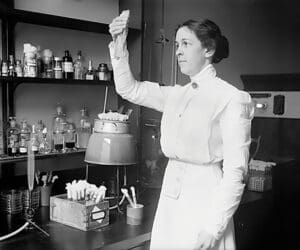
Alice Catherine Evans
Do not confuse this article as dealing with bangs disease alone. It is a historical piece of my favorite kind. I find the subject fascinating; a stubborn woman raised in the humblest manner, ridiculed and rejected repeatedly in her quest for a better education and finding good jobs through loopholes and hapless mistakes made by employers. It makes me smile.
The improbable success of Evans began with her birth in 1881 to her parents, a farmer/surveyor and a schoolteacher mother in Neath, Pa. Neath was named for a town bearing the same name in Wales, bespeaking Evan’s ancestry. She was home schooled for two years before entering the one-room public education system in her hometown, where she received outstanding grades.
Evans moved on to the Susquehanna Collegiate Institute in Towanda. She had the audacity to play on the women’s basketball team, an atrocity that was considered shockingly unladylike by the general populace. Her enthusiastic efforts on the court once resulted in a dislocated finger, which a local doctor refused to treat, disliking the behavior if sporting women as less than demure.
According to Wikipedia, after graduation, Evans joined the “only profession she found open to women, teaching.” After four years, she could no longer tolerate the boredom and took a course free to rural educators offered by Cornell University. It was intended to help teachers inspire their students to love science and nature; instead, it inspired Evans to embrace bacteriology. She received a scholarship in science, armed with free tuition from Cornell University, encouraging students to pursue the newly minted specialty. To augment her income while at Cornell, Evans worked as a housekeeper and did clerical work in the alumni library. She earned a less-than flattering nickname – “The Grind.”
After earning a B.S. in bacteriology from Cornell in 1909, she was the first woman to receive a bacteriology scholarship from the University of Wisconsin-Madison. Within a year, she’d attained her master’s degree. Evans was offered a fellowship in chemistry at the University of Wisconsin, but due to financial constraints, decided to enter the work force instead.
She took a job with the Bureau of Animal Industry at the USDA in Madison, Wis., researching the source of bacterial contamination of milk products. She was the first woman to hold a permanent position at the USDA as a civil servant, and as such was protected by law. Nonetheless, she decided that she was hired by accident. To protect her status, she took one undergraduate course each year and learned German in order to read research reports by German scientists who, prior to WWI, led the world in bacteriology.
Ever one to continue a battle, Evans applied for a job with the USDA in a newly constructed facility in Washington, D.C. The Bureau of Animal Industry had successfully blocked women from their work force, but Evans was “unwittingly admitted through a loophole.” She found the Dairy division more welcoming than the larger bureau. Later, Evans was sent to Chicago to study mycology (the study of fungi) and then returned to D.C. to replace the head mycologist there.
The Great Discovery
It was during this time (I can only decipher approximately around 1915) that Evans became interested in brucellosis and the organism Bacillus abortus. She discovered it was found in cow’s milk and therefore was a likely source of infection in humans. The fact that perfectly healthy-looking cows could carry the disease only strengthened her hypothesis that it put humans at risk.
Evans began drawing the line between bangs and undulant fever in humans. Since pasteurization of milk was a new idea, there was a widespread disregard for the process; however, Evans fought hard to promote pasteurization to prevent Bangs and other bacterial infections from spreading to the human population. She reported her findings to the Society of American Bacteriologists in 1917 and published her findings in the Journal of Infectious Diseases in 1918. Pasteurization of milk was slow to catch on; today’s data states that only about 4 percent of milk in the United States is consumed raw. Evan’s hypothesis was verified with time.
Other Facts
Evans also studied epidemic meningitis, a disease that plagued WWI. She was infected with influenza and confined to her bed for a month after her studies in flu left her ill. She was one of the first scientists to research Streptococci bacteria. In 1922, she contracted brucellosis, or undulant fever, which impaired her health for 20 years.
She became a popular speaker in her retirement, giving talks to women about career development and scientific careers. She passed away at the age of 94 in 1975.
Because of Evan’s work, brucellosis was recognized as an occupational hazard to farmers and threat to our food supply. She is currently being inducted into the National Dairy Shrine.