By Burt Rutherford Contributing Editor

The cattle business, as those of you reading this are fully aware, can be tough. It can be hard physically. It can be hard mentally. And it can be hard emotionally.
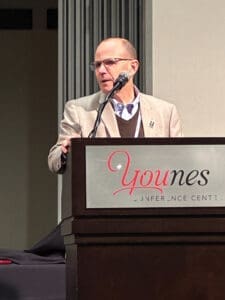
“So what is it that drives us? What motivates us, generation after generation, to try to improve these cattle?” Tom Field, Ph.D., asked Hereford leaders from 20 different countries at the 2025 World Hereford Conference in Kansas City, hosted by the American Hereford Association.
He has a few ideas about that. “I think it’s deeper than money,” said the fifth-generation rancher and head of the Engler Agribusiness Entrepreneurship Program at the University of Nebraska-Lincoln. “It’s deeper than pride.”
He looked at the words of Miguel Cervantes, who wrote of the exploits of Don Quixote, for an answer. “Cervantes wrote, ‘Too much sanity may be madness. And the madness of all is to see life as it is and not as it should be.’ I think that’s the truth that drives us to see what’s possible,” Field said.
Or perhaps the answer is in the words on his and many others’ childhood hero, John Wayne: “‘Tomorrow’s the most important thing in life. It comes into us at midnight, very clean. It’s perfect when it arrives and puts itself in our hands, and it hopes we’ve learned something from yesterday.’ That, too, is what drives us; to take what we’ve learned and apply it to change the future,” he told Hereford breeders.
And that’s what beef producers worldwide have done over the generations. To illustrate that, he took the global Hereford leadership back about 30 years to an educational exercise that he and others did for the 1996 World Hereford Conference. They found semen from 1950s Hereford bulls, 1970s Hereford bulls and 1990s Hereford bulls to quantify the genetic changes over those years.
“There was about 100 pounds in off-test weight difference from generation to generation. Certainly some changes in average daily gain. But what was interesting – feed conversion was only slightly different,” Field noted.
What’s more, the maturation of the cattle wasn’t as different as the team expected. “But here’s the most exciting thing we saw, at least from my perspective. When we took the EPDs and looked at what we expected to see between the 1950s and the 1970s; the 1970s and the 1990s; and the 1950s and the 1990s, as estimated by the EPDs, and looked at the actual differences in phenotype, it was remarkable. Guess what? EPDs work.”
So it’s prudent to trust the science behind the genetic selection tools available to beef producers. “But we also have to trust our intuition, what we know about being on the land with these cattle,” he explained. “So there’s this beautiful merger of common sense and good science.”
Comparing pictures of the belt buckle cattle of the 1950s and the hat high cattle of the 1970s and the leaner cattle of the 1990s is proof enough that genetic selection can change the composition of cattle dramatically. The team took representative animals from each generation, eviscerated them and then froze them. The 1950s steer had nearly an inch of backfat and a ribeye that some pigs can exceed today, he said. “And on the 1990s steer, considerably less fat, more muscle – a completely different animal in its composition,” he said.
“Marbling had gotten better from the ‘50s to the ‘70s, and then we lost a little progress as we chased growth in the ‘90s. We were trying to make them leaner and bigger. And when we did, what did we do? We lost a little bit of our momentum in marbling. But over time, we had improved the composition, the mix of quality grade.”
They were also able to demonstrate net profit in the cattle. “And it was clear that we made more profitable cattle over that period of time. And what this reminds us of is that we can, in fact, have an impact. We can change tomorrow through using the tools we can harness in the way of genetic evaluation.”
The changes in cattle from the 1990s to today have been every bit as dramatic and profound, if not more so, than the changes from the ‘50s to the ‘90s. What have we learned in the past 30 years?
“The most important thing we have learned is that when you take the power of selection and the power of heterosis for a commercial cow-calf producer, you improve their profitability and their sustainability,” Field said. “When we leave either of those tools – selection or crossbreeding – off the table for commercial breeders, we make it harder for our customer,” he admonished the seedstock producers in the room.
What does the future hold? It’s doubtful that anyone back in the 1990s would have predicted the changes in the beef business from the then to today. Will we indeed produce 1,500-pound carcasses, as has recently been predicted? Only time will tell.
Looking ahead, Field told Hereford leaders that they can choose one of two ways to go about their business and their lives. “We can either play a finite game or we can play an infinite game,” he said. “And it matters not where we live.”
In the finite game, the thinking is short-term, often in quarters. The players are known, the rules are set and there’s a definite ending to the game.
“And the question that drives us in the finite game is what’s best for me,” he said.
“Then there’s the infinite game. We think in generations. There are both known and unknown players. The rules are in flux. There’s no endpoint. The goal is to stay in the game, and what drives us is what’s best for others.”
He speaks from experience when he says the finite game will ultimately not end well. “I tried to play the finite game on our family ranch, and we made a lot of mistakes. When we got our minds back to playing the infinite game, we got better. Our cattle got better. Our family got better.”
We get to pick, whether it be with genetics, management approach or any of the myriad other decisions that happen daily, he said. “Sometimes we get it right, sometimes we miss. But we get a chance to leave a mark, a legacy, and that’s important. It matters.”