By Larry Stalcup Contributing Editor
Using CT scanning, Texas Tech University (TTU) researchers are making more accurate measurements of beef carcass red meat value, something that “is long overdue” in a virtually archaic industry beef grading system.
Those contentions by Dale Woerner, Ph.D., TTU meat science professor and researcher, were ruminated during his recent presentation at the Oklahoma Cattlemen’s Association’s (OCA) 73rd Annual Convention & Trade Show in Norman. It was part of OCA’s recognition of its “heritage of innovation.” Other convention speakers examined production and carcass improvements, marketing, the weather and animal health, which included being ready to take on New World screwworm.
“Our convention offered cutting edge seminars and opportunities to explore new ideas while honoring our tradition of forward thinking,” said OCA Executive Vice President Michael Kelsey. He and others in the industry continue to question the accuracy of carcass grading.
Cattle production has changed immensely since the grading system was introduced in 1962. “Yield grading has outdated many of us,” Woerner said. “It was designed to segregate carcasses based on value by estimating the proportion of the carcasses that results in boneless, closely-trimmed retail cuts. But it makes no reference to carcass trim used to make ground beef, which constitutes greater than 40 percent of the product weight coming from carcasses.
“Not estimating the true value of trimmings is a huge miss in regard to true red meat yield.”
High-tech cameras have helped USDA graders. The primary use of today’s ribeye camera is to determine the USDA Quality Grade, including Prime, CAB, Choice, Select and lower grades.
“Grading cameras accurately measure ribeye area; however, the ribeye area alone explains only 3 percent of the variation of saleable red meat from the carcass,” Woerner said. He added that the current Yield Grade system only explains a small percentage of the total variation in saleable yield on an individual carcass basis.
His Texas Tech research studies have expanded the technology with artificial intelligence. “We can take a visual image of a carcass,” he said. “Every visual image is data, where pixels provide independent measurement. Using artificial intelligence, we can obtain a more holistic measurement of the carcass.
“We can explain up to 96 percent of the carcass variation.”
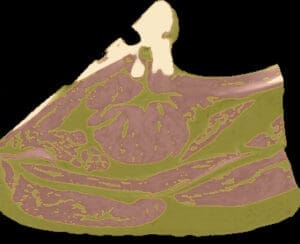
CT scanning takes it to another level. “We can use 3-D imaging, but it is still a prediction of carcass yield,” Woerner said. “But CT scanning is a measurement of true yield. The CT measures pixels and differentiates muscle, fat and bone. It can determine how much sirloin, top round or other muscles are in a carcass.”
Woerner’s research team has a portable CT scanner on wheels large enough to scan a carcass side. “We’ve gone to the possibility of measuring every carcass and knowing what’s going into the box [at the packer],” he said. “We’d like to use CT scanning to train other technologies, and virtually cut a carcass without using a knife.”
Starting in October, the Texas Tech meat research crew expects to CT scan about 500 carcasses in the next 18 months. “We need to get a better idea of what carcasses will do,” he said.
“Not estimating the true value of trimmings is a huge miss in regard to true red meat yield.”
– Dale Woerner, Texas Tech University
Herd Expansion?
Derrell Peel, Oklahoma State University Extension livestock marketing specialist, said the hope for beef herd expansion continues to see flat numbers. “Cow slaughter continues to decrease, but the cow herd is not growing like it needs to be,” he said. “The July 1 beef cow inventory doesn’t suggest [overall] that producers are saving many replacement heifers.
“Heifer feeding percentage [of cattle on feed] was a little higher in the report. It’s still about 38 percent when we thought it might come down.”
Oklahoma’s summer saw gully washers and plenty of green pastures. The rainy trend continued into August and early September. The result is a promising winter wheat crop for grazing. And with the value of calves and all cattle, Peel said that cow-calf and stocker operators will consider their options for grazing over the winter.
“The value of [475-pound] calves has increased by nearly 135 percent in a three-year period, increasing from less than $1,000 per head to almost $2,300,” he said. “The value of yearlings has increased over 110 percent in the same period.”
New OCA Officers

During the convention, Ford Drummond of Pawhuska was named OCA president for the 2025-2027 term. EVP Kelsey said OCA has always been blessed with strong leadership, and Drummond fits into that line of leaders. He added that Oklahoma cattlemen and women are aware of the threat of the New World screwworm (NWS). He assured producers that OCA would work closely with the USDA and state animal health officials to control any NWS issues that face Oklahoma and neighboring states.
For more on OCA, visit okcattlemen.org.