By Larry Stalcup Contributing Editor

keep producing high-quality beef meeting the demands of consumers across the globe.”
With strong but jittery cattle markets, the border closed to Mexican cattle, more New World screwworm (NWS) threats, the government shutdown and other issues, Robby Kirkland was among many cattle feeders wondering what will be next to impact the feeding industry.
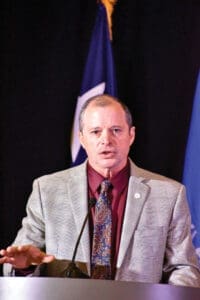
Kirkland, outgoing TCFA chairman, was among the speakers at October’s Texas Cattle Feeders Association (TCFA) Annual Convention in Fort Worth. He emphasized that TCFA remains steadfast in its leadership role in industry efforts to mitigate the growing threats from NWS and other issues that could disrupt cattle production and marketing.
Kirkland said many TCFA area feedyards felt the impact of the Mexican border closure after the NWS outbreak. Nearly 1.2 million cattle are typically imported from Mexico per year. But (at press time) the border had been closed since early July. That border halt added to the lowest beef cattle numbers in 70-plus years. Fewer feeder cattle have forced many yards in Texas and elsewhere to feed cattle to higher weights. But quality has not suffered.
“Even with fewer cattle on feed, cattle feeders have persevered to keep producing high-quality beef, meeting the demands of consumers across the globe,” Kirkland said. “We have fed cattle to heavier weights, and U.S. cattle producers produce more pounds of beef even with a decrease in the number of cattle harvested.
“This proves the resiliency and ingenuity of every person sitting in this room. We have embraced technology to continue to produce the highest quality, safest beef in the world. It’s a product that American and international consumers continue to buy, despite higher prices at the grocery store.”
Concerning NWS, he said TCFA is advocating for the construction of new sterile fly production facilities in South Texas, other states and Mexico. The association also supports approval of additional treatment options and implementation of stringent inspection and treatment protocols to enable the reopening and continued operation of the southern border ports.
“We are a founding member of the Screwworm Coalition of Texas, which works together to prepare and protect livestock and wildlife producers,” Kirkland said. “We serve on the Texas New World Screwworm Response Team, which is jointly led by the Texas Animal Health Commission and Texas Parks and Wildlife Department.”
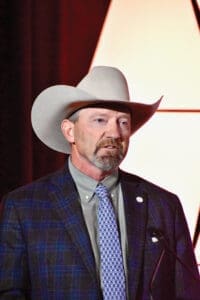
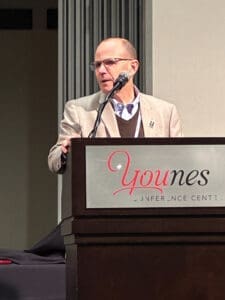
Another featured speaker, NCBA President Buck Wehrbein, discussed the major issues facing producers and feeders, and reminisced about his time managing a feedyard in the Texas Panhandle. Wehrbein, a Nebraska native, has managed feedyards in his home state and Texas since the 1980s. After a short stint at a Castro County, Texas, feedyard, he became part of the Randall County Feedyard staff. “I grew up in the business at Randall County,” he said.
He worked on various TCFA committees when it was headed by the legendary Charlie Ball and later Richard McDonald. “Richard was as good as it gets in livestock association work,” he remembered, noting that those two and later former TCFA CEO Ross Wilson were among his mentors during his 20 years in the Texas Panhandle.”
Wehrbein urged today’s cattle feeders to read Charlie Ball’s book, The Finishing Touch. “Early Texas feeders made many sacrifices for us,” he said. “I have soft places in my heart for this association.”
The many issues facing the cattle industry and all of agriculture dictate that crop and livestock producers need formidable voices nationally. “We need someone in Washington looking out for us. That’s where we need NCBA,” he said. “They are such a good representative for us. The policy NCBA follows starts with you and other state cattle associations. It’s truly a grassroots organization.
“What TCFA and others do, and what we do at the [NCBA] midyear meeting, is what guides the NCBA staff. We don’t do anything that is not in the policy book. The checkoff doesn’t do anything that is not in the long-range plan.”
Concerning President Trump’s trade deals (prior to comments later on Argentina beef), Wehrbein said, “We’ve actually got Australia to take fresh meat from us, which was supposed to have happened 15 to 20 years ago.”
Even though the new Farm Bill hasn’t been passed, Wehrbein said, “it looks like it will be the best Farm Bill cattlemen have ever seen. With the Big Beautiful Bill, we got 90 to 95 percent of it done. That was huge.”
He noted that extensive outlays for animal health, conservation programs, Livestock Risk Protection risk management tools, and keeping the Death Tax from hurting many smaller cattle operations were victories for agriculture.
Like many in agriculture, Wehrbein was skeptical of Robert F. Kennedy, Jr., being named U.S. Secretary of Health and Human Services. “I thought, ‘this is a wreck.’ Then he said he cooks his turkey in beef tallow, and he tweeted in favor of more beef jerky. When MAHA [Make America Healthy Again] came out, it was good for us. Now, we have fat back in [the diet] and everybody loves it.
“Demand for our beef [is huge],” Wehrbein added. “A lot of that is due to the Beef Checkoff. We’re defending the checkoff against those who don’t like it. I understand those who feel it may not be set up right. But I don’t see why you would burn your house down, when [the checkoff] is working and doing a good job. Our [checkoff] referendum is 76 percent positive. I encourage you to always defend it.”
New TCFA Officers
Laphe LaRoe, a cattle feeder from Amarillo, is TCFA’s 2026 chairman. He is joined on the officer team by Ben Fort of Amarillo, serving as TCFA chairman-elect, and Warren White of Hereford, who steps into the officer rotation as TCFA vice chairman.
TCFA CEO Ben Weinheimer discussed these points during his association year-in-review:
- 96 percent of TCFA’s 163-member feedyard capacity is BQA certified.
- The cattle feeding region has a $16 billion economic impact on Texas, New Mexico and Oklahoma.
- TCFA member feedyards finished some 3.1 billion pounds of beef last year, enough to feed 55 million consumers.
- TCFA youth programs provided more than $90,000 in scholarships and other educational high school and college students.
Post TCFA Convention Action
During the TCFA Convention, CattleFax CEO Randy Blach warned producers, feeders and others to use risk protection to prepare for market disruptions. Only a day or two later, cattle markets plunged unexpectedly following President Trump’s consideration that the U.S. may import more Argentina beef to lower consumer beef prices.
The negative impact caused a limit-down market movement. TCFA indicated such incidents serve as a reminder that remarks like these have serious implications on cattle markets. The Argentina issue didn’t set well at NCBA. “NCBA and its members cannot stand behind the president while he undercuts the future of family farmers and ranchers by importing Argentinian beef in an attempt to influence prices,” NCBA CEO Colin Woodall said. “It is imperative that President Trump and Secretary of Agriculture Brooke Rollins let the cattle markets work.”
On a positive note, in late October Sec. Rollins announced a major plan to “fortify the beef industry, strengthening ranches, rebuilding capacity and lowering costs for consumers.” The program addressed veterans and ranching; streamlined grazing lands; improved USDA livestock and forage risk programs; volunteer USA labeling; reducing costs for small beef processors; and enhanced access to feeder cattle data.
“We commend President Trump and Sec. Rollins for continuing to prioritize issues important to cattle producers and beef consumers,” TCFA Chairman Laphe LaRoe said. “While cattle inventories have reached a 70-plus-year low, consumer demand for beef remains high, and we look forward to continuing to work with the Trump administration to ensure consumers have access to the safe and nutritious beef they desire. “
TCFA officials also joined Sec. Rollins and U.S. Trade Ambassador to Mexico Ronald Johnson in attending a U.S. trade mission to Mexico. The goal is to extend export opportunities for American farmers, ranchers and agribusinesses by expanding economic opportunities, supporting rural prosperity and keeping American agricultural products globally competitive.
On the NWS control front, TCFA noted that a new sterile fly dispersal facility has opened in Tampico, Mexico. The Tampico facility will allow USDA to disperse sterile flies aerially across northeastern Mexico, including in Nuevo Leon, if necessary.