By Larry Stalcup Contributing Editor
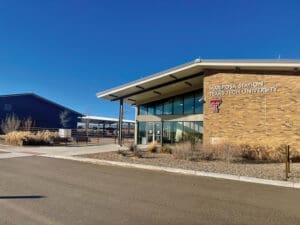
After beginning as a dream barely a decade ago, the Texas Tech University School of Veterinary Medicine (SVM) in Amarillo has earned full accreditation by the American Veterinary Medical Association Council on Education.
“This achievement marks a defining moment for Texas Tech University and for veterinary education in Texas,” says Texas Tech President Lawrence Schovanec. “Accreditation affirms the quality of our faculty, the dedication of our students and the innovative model that has guided the School of Veterinary Medicine from the beginning.”
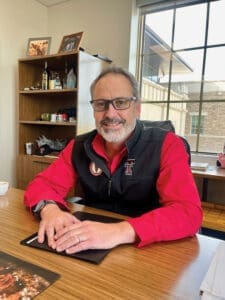
The SVM becomes the 31st fully accredited vet school in the nation. “Across well over a century of veterinary education in the U.S., we are now one of a select few,” says SVM Dean Guy H. Loneragan, BVSc, Ph.D. “At the core of this achievement is the belief in our purpose and a belief in providing opportunity for those who will achieve this purpose – our students.”
The accreditation honor came several months after the SVM saw its first students earn their DVM degrees in May. The vast majority of them started their careers in a practice that serves the veterinary needs of rural, regional or large-animal communities, a main reason behind the SVM being approved by Texas Gov. Greg Abbott in 2019. Texas annually produces about 12 million cattle, some 13 percent of the nation’s cattle inventory. Nearly 6 million cattle are finished annually at Texas, Oklahoma and New Mexico feedyards, accounting for 25 to 30 percent of the nation’s total fed-cattle supply.
Most are within a 150-mile radius of Amarillo. However, before the Texas Tech SVM was established and opened in 2021, the closest vet school was about 320 miles away at Oklahoma State University in Stillwater. Texas A&M University’s vet school is about 500 miles away and was the only vet school in Texas before the SVM opened.
SVM welcomed its first students in 2021. There were 61 students in its first graduating class. “We knew we were going to get good students, based on their roots from rural and regional communities,” Loneragan tells CALF News. “They showed just how resilient they were. They demonstrated a lot of grit and common sense. They carried the values we all know. I was expecting good students, but we got better students than I had even hoped for.”
Loneragan is a native Australian. He was raised in a rural community and worked on his family’s cattle ranch. His father was a vet and provided reproductive services for livestock producers across much of eastern Australia. After completing vet school in the 1990s, Loneragan came to the United States in 1995. He moved to Texas at the very end of 2001 as a faculty member at West Texas A&M University in Canyon. In 2010, he joined the Texas Tech animal and food sciences department. He was part of the original SVM team when the school was still on the drawing board some 10 years ago.
“There was concern that there weren’t enough large animal vets in Texas and other rural areas,” he says. “The Texas Legislature supported us for two reasons: Texas needed more rural and regional-serving veterinarians, and there was no shortage of Texans who wanted to be veterinarians. The legislature invested in the educational process to help those Texans who wanted to be vets and support the veterinary professional needs of Texas.”
The inaugural class started with 64 students. Those numbers have grown to 100 students per year. Including the graduates, there are more than 420 students. There are up to 140 faculty and staff. “The SVM purpose is rural and regional,” Loneragan emphasizes. “Approximately 93 percent of the students are from Texas. The remaining students are from New Mexico.
“We are in proximity to New Mexico, which does not have a vet school. Part of our stakeholders work on both sides of the border.”
SVM’s unique curriculum includes three pre-clinical years at the Amarillo campus. The fourth year involves clinical training at about 140 locations and on campus. Fourth-year students train at general veterinary practices in rural and regional communities, and allied industries such as feedyards and dairies.
“The graduating class exceeded all expectations,” Loneragan says. “More than 90 percent of the students started in rural, regional or large animal practices. About 70 percent are in mixed animal or large animal practices.”
The vet school is involved in various research projects, including those that examine the cost of treatments to prevent and control BVD, BRD and other diseases. SVM is part of the Texas Screwworm Coalition to help the cattle industry prepare for the potential infestation of New World screwworm in Texas beef and dairy herds and wildlife.
“Part of our purpose is to support rural and regional communities. But we also strive to provide students with access and affordability,” Loneragan says. “We’re pleased with the generous support of donors who have been able to support and invest in the future of the profession.
“We will always love to have more people willing to step up to help these students so that when they graduate, they won’t be slowed down by the debt they carry when they set up in rural and regional communities. We’re very excited about that side of our purpose – affordability. It takes all of us to make a difference.”
By receiving full accreditation, Loneragan says it marks the transition from a developing program to one that is nationally recognized for meeting standards, missions and goals. It assures students that the education provided will prepare them for their licensure to practice as a veterinarian in Texas and across the nation.