By Linda Lockwood Contributing Editor

Earlier this summer, my husband and I travelled to Omaha, Neb., for the weekend. Our primary focus was to be the Union Pacific (UP) Railroad Museum and other railroad-related sites. We also visited the Durham Museum in the Historic Omaha Train Station, which was very interesting as they track the role the railroads had in the development of Omaha and the American West.
The expanding railroad systems allowed Omaha to become a major player in the stockyards, beginning with the first shipment of 531 cattle in 1884, handled by Union Stock Yards. By the end of the first year of operations, the stock sards handled 117,000 head of cattle. By 1955, Omaha had overtaken Chicago for the title of the nation’s largest livestock market and meatpacking center.
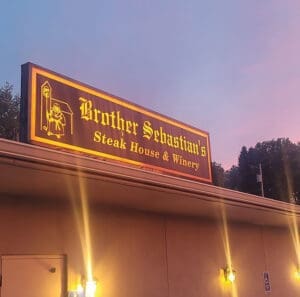
It only made sense, then, that the meatpacking industry would follow, and soon steakhouses would open, showcasing Omaha’s beef. These steakhouses proliferated through the heyday of the Stock Yards, which closed in 1999. A few of these “old school” steakhouses still exist, and we were fortunate to try Brother Sebastian’s Steak House & Winery, which remains a classic.
Brother Sebastian’s opened in 1977 to provide diners with a place to get away to a venue inspired by the Spanish monasteries in California. Although the building burned to the ground in 1996, it was soon rebuilt and reopened in a mere eight months. Guests are greeted with Gregorian Chants as they enter what resembles a Spanish monastery, and the servers carry on the vibe dressed in monk attire.
Keeping with the California influence, the restaurant boasts an extensive wine list, most coming from California. The original owner wanted to bring good wine to the table. And it is fitting since some say it was the monks who brought wine to America. The wine list continues to be very good and fairly priced. They also offer half bottles, which is a nice option if you must go to work the next morning.
And now, finally, to the food. We shared an amazing shrimp scampi appetizer baked in a generous amount of garlic butter and havarti and mozzarella cheeses. I don’t often think of shrimp scampi with cheese, but this was perfectly delicious.
We then took a trip to the extensive salad bar. The restaurant remains much the same as it was on Day 1 of operation, according to our excellent server, Greg. One of the features that regulars insisted they keep is that impressive salad bar, which many of us remember as a staple of dining in the ‘70s and ‘80s. All the ingredients were fresh and well-chilled. We were pleased that they have maintained that tradition.
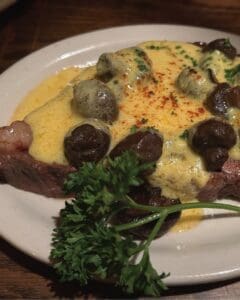
The restaurant’s specialty is slow cooked prime rib. They serve wet-aged Nebraska Angus. I ordered the Prime Rib Benedictine that came with melt-in-your-mouth mushrooms and a lovely hollandaise sauce. I prefer a medium-rare temperature, and that is precisely what was brought to the table. Little wonder that it is the house specialty. My husband’s medium-well filet was also perfectly prepared, although not as dramatic as my prime rib! The mashed potatoes that we shared were another simple pleasure.
We were seated in a small library for dinner and had access to an array of old books, which became a part of the discussion with our attentive server and restaurant owners Debbie and Scott Lurry. I browsed through Railway Accounting Procedures, published in 1928. It left me very thankful to be in a Microsoft Office world. I could write an entire review of that little library; the books were that interesting.
While we were reading books and leaving our signatures and messages in these volumes (yes, that is encouraged), Debbie chatted with us. She has been at Brother Sebastian’s for 43 years, hired by her now husband who said she was “too cute for bussing tables, but what the heck?”
We enjoyed a quick tour of the restaurant – a series of themed dining rooms – during which we heard more stories about the restaurant, which by now we had grown to love. While the other dining rooms were interesting, we thought we had the best seat in the house, however, because of the library.
Sharing the cherries jubilee over ice cream rounded out the evening. We felt entitled to dessert since we had passed on the bread. We left very satisfied and feeling fortunate to have had the experience with workers striving to keep the traditions and yet keep it all fresh.
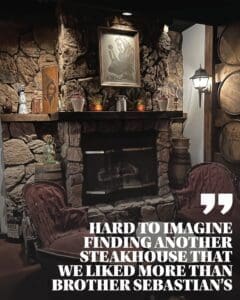
There are more museums to visit in Omaha, and we hope to go back. It will be hard to imagine finding another steakhouse that we liked more than Brother Sebastian’s, so I suspect we won’t try another the next time we are there. Should Omaha be a destination, I hope you will visit Brother Sebastian’s.