By James Coope Contributing Editor
We’ve featured dozens of great restaurants from around the world, but is it possible to find a great steak near the Arctic Circle? Yes – and it can be found at Steikhúsið (Icelandic for “The Steakhouse”) in Reykjavík, Iceland.
Iceland is an island nation that may be one of the most remote and geographically isolated places on the planet. Located just south of the Arctic Circle and hundreds of miles from its nearest neighbors, it is surrounded by cold ocean waters, battered by frequent polar storms and sits on an active tectonic rift where the Eurasian and North American plates are diverging at nearly one inch per year. With very few indigenous plants or animals, Iceland remained largely untouched until Viking settlers arrived around A.D. 870.
The Vikings did not arrive alone. They brought cattle, sheep, horses, poultry and dogs with them. These animals faced few natural predators – the only land mammal on the island before human settlement was the Arctic fox, which arrived during the last Ice Age. Centuries of isolation allowed Iceland to develop a unique agricultural system, and its livestock are now among the most genetically pure populations in the world.
The cattle brought by the Vikings are the ancestors of today’s Icelandic cattle breed. The breed has remained genetically isolated for hundreds of years in large part because Iceland has banned cattle imports and avoided crossbreeding. As a result, modern Icelandic cattle are in many ways the same animals that first arrived more than 1,100 years ago. Compared with most commercial cattle breeds, Icelandic cattle are smaller and slower growing, with stronger muscles that produce leaner meat and distinctive flavor compounds. During the warmer months, they roam the countryside, grazing on wild grasses, moss, hay and herbs.
Although beef production in Iceland is smaller than poultry or lamb, demand for Icelandic beef is strong. Reykjavík, the nation’s capital and largest city, is home to several steakhouses. One of the most notable is Steikhúsið located on the city’s historic harbor. What makes Steikhúsið unique is that it dry ages most of its Icelandic beef and cooks it in a Mibrasa charcoal oven, the only one of its kind in the country.
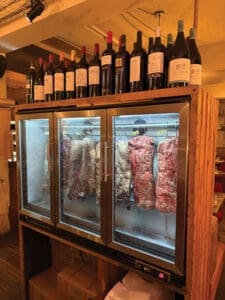
Steikhúsið is housed in a former metalworks building, giving it a rustic atmosphere with exposed timber beams and concrete walls. When you walk in, you are immediately surrounded by dry-aging cabinets filled with dozens of beef cuts. Because Icelandic beef is naturally lean and firm, dry aging allows enzymes to break down dense muscle fibers, improving tenderness and intensifying flavor. Iceland’s cool, clean air, stable humidity and low bacterial load provide ideal conditions for extended dry aging, often longer than is possible in many other parts of the world. At Steikhúsið, most of the beef served comes directly from the on-site aging cabinets.
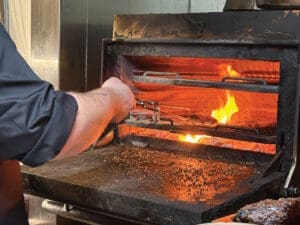
The restaurant is also known for its Mibrasa charcoal oven, where most of the food served at Steikhúsið is prepared. To ensure consistency, Steikhúsið uses only Yakitori charcoal – a dense hardwood charcoal that burns at very high temperatures with minimal smoke. The oven can reach temperatures of up to 700 degrees Fahrenheit, allowing for even cooking and precise control of browning. The chef explained that this precision helps create optimal Maillard reactions, locking in juices while maximizing flavor.
On a cold November night in Reykjavík, we started with slow-cooked Black Angus short ribs that may have been the best I have ever tasted. Lean yet intensely flavorful, they were served with artichoke purée and pickled red onions, and made a perfect introduction to the meal. For our main courses, we chose the Icelandic ribeye and the Icelandic tenderloin. Both were served on wooden cutting boards – a distinctive and traditional touch at Steikhúsið. From preparation to presentation, the quality of the beef matched the restaurant’s reputation.
A friend once described Iceland to me as “brutally beautiful,” and the phrase certainly fits. Volcanoes dot the landscape, some still active, while long, dark winters bring fierce storms and isolation from the rest of the world. Yet the Icelandic people have adapted over centuries to create a culture that feels both resilient and timeless.
Enjoying a dry-aged Icelandic steak cooked over charcoal in a place like Steikhúsið feels about as primal and elemental as dining gets – and it is a memorable experience.